
Concrete Sidewalk Building in Glendale AZ
Concrete sidewalk building for front walks, side paths and connecting runs, shaped so feet, strollers and wheelchairs all roll over them safely.
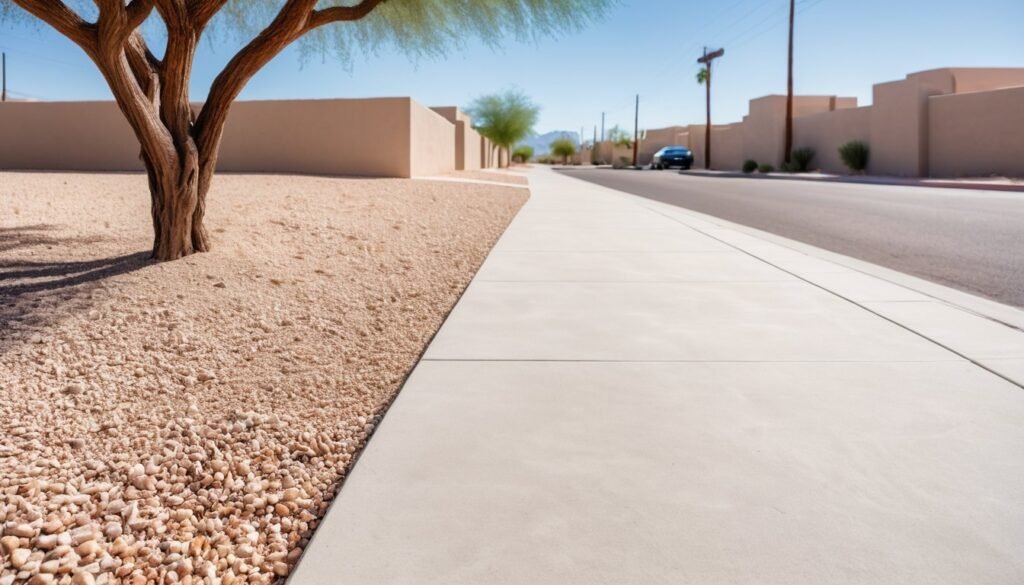
A walk should feel boring to use, and that is the goal
Nobody thinks about a good walk. They only think about a bad one: the corner that trips the mail carrier, the puddle that stays after a monsoon, the slab that tilted when a tree root moved. Concrete sidewalk building is about making sure nobody ever has to think about it.
In Glendale, AZ we build front walks from the driveway to the door, side yard paths to the back gate, garden connectors and wide accessible routes. We plan width, slope, joints and drainage before the first form goes in, because those four things decide how the walk behaves for the next twenty years.
Concrete sidewalk building starts with where the water goes
Water is the thing a walk has to deal with. Sprinklers throw it, monsoon storms dump it and roof gutters send it. We set a small cross slope so water leaves the surface, and we make sure it flows toward a lawn, a gravel strip or the street instead of toward your front door or a neighbor's wall.
We also look at the ground under the walk. Soft fill, old trench lines and spots where the irrigation leaks all lead to sinking. A few hours of base preparation prevents years of trouble.
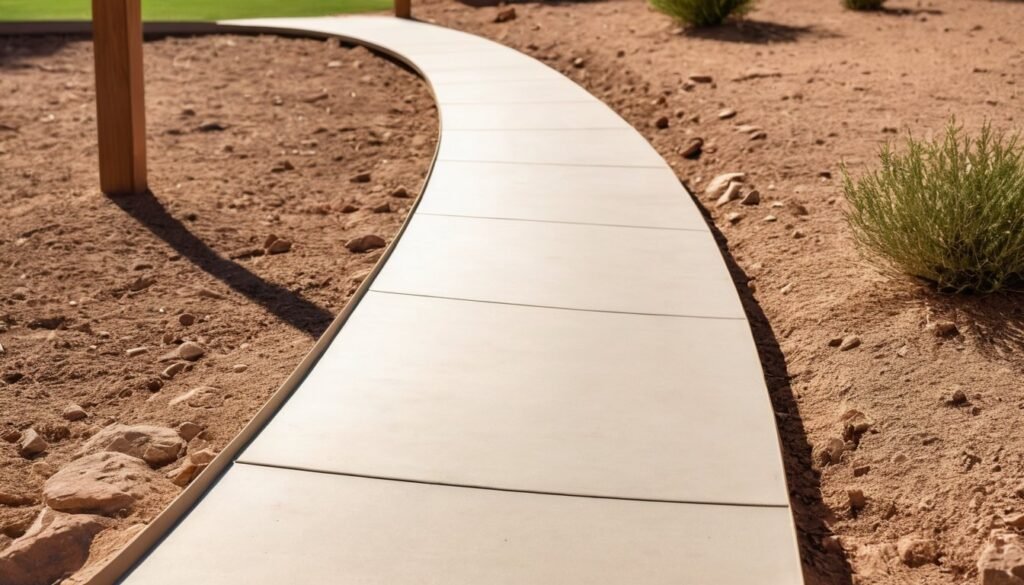
Walk types we build
| Walk | Typical width | Good to know |
|---|---|---|
| Front entry walk | 48 to 60 inches | Wide enough to carry groceries and guests, with a landing at the door |
| Side yard path | 36 to 42 inches | Narrow, firm, and shaped so trash cans roll easily |
| Accessible route | Wider, with gentle slopes | Built to be comfortable for walkers, canes and wheelchairs |
| Garden connector | 30 to 36 inches | Often with a broom finish and curved edges |
Concrete sidewalk building questions from Glendale homeowners
What does concrete sidewalk building cost, and what changes the price?
Concrete sidewalk building is priced mostly by length, width and thickness, plus how hard the site is to work on. A straight front walk is cheaper per foot than a curved one with steps and planter edges. A walk with an easy path for the truck is cheaper than one that must be carried by wheelbarrow through a side yard gate.
The main price drivers are these. Demolition and haul away, if there is an old walk to remove. Base preparation, which gets more work if the ground is soft or uneven. Thickness, since a walk that crosses a driveway needs to be thicker than one that only sees foot traffic. Finish, such as a plain broom finish compared with color or a border. And extras, like a landing, steps, curbs or a connection to a patio.
We give a written estimate that lists each part, so you can see what costs what, and where a change would save money. A narrower walk, a simpler path or a plain finish all lower the price.
The cheapest walk is not always the best deal. A thin slab on a poor base will crack and tilt, and that costs more later. We aim for a fair price on a walk you will not have to replace.
How wide and how sloped should a walk be for easy, safe use?
For a walk that people use every day, we like at least 36 inches clear. That is enough for one person to walk comfortably and for a wheelchair to pass. For a front walk where people pass each other, carry packages or walk side by side, 48 to 60 inches feels generous and welcoming.
Slope matters just as much. We build a gentle cross slope of about 2 percent, which means a quarter inch per foot, so rain runs off sideways without making the walk feel tilted. Along the length, a gentle run of 5 percent or less feels like a walk. Anything steeper starts to feel like a ramp, and then handrails, landings and different rules apply.
If the walk will be used by a person in a wheelchair, or you want to plan ahead for aging in place, tell us. We will use gentler slopes, smoother finishes and wider landings at the door.
Public sidewalks in the city right of way follow their own rules from the City of Glendale, so for those, please check with the city first. For private walks on your property, we follow good accessibility practice as a starting point, and we will talk through your needs before we pour.
How do you keep a concrete sidewalk from cracking or lifting?
Concrete cracks. That is its nature. Concrete sidewalk building is about controlling where it cracks, and making sure the walk stays level when it does. There are four main tools.
The first is a solid base. We remove soft soil and organic material, then compact a layer of gravel or base so the walk sits on firm ground. The second is joints. We cut control joints about every five feet, which is about the width of the walk, so that stress finds the groove instead of making a crack across the middle. Expansion joints go where the walk meets a driveway, a wall or a step.
The third is thickness and reinforcement. Four inches is standard for foot traffic. We go thicker where the walk crosses a driveway or is used by a mower or a cart, and we may add wire or fiber reinforcement.
The fourth is moisture and roots. Large trees can lift a walk, so we place the path away from thirsty roots when we can, and we ask you to keep sprinklers from soaking one side of the slab.
These steps will not prevent every hairline crack, but they keep the walk safe and level.
Can you fix a sidewalk panel that has lifted or sunk, or do you replace it?
It depends on the cause and how far it has moved. If a panel is raised by a tree root, we can sometimes cut the panel out, trim the root where it is legal and safe to do so, and place a new panel on a fresh base. If a panel has sunk because of washed out soil, we can often lift it back to level or replace it.
Small height differences, up to about an inch, create tripping hazards, and that is where a repair has the biggest safety benefit. Grinding the high edge smooth is a quick fix for a very small lip. For larger steps, leveling or replacement is better. You can read about our leveling work on the concrete leveling page.
If a sidewalk is cracked in many places, spalled on the surface or sloped the wrong way, replacement of the whole run often makes more sense than patching. We will give you both options and a plain opinion on which one is smarter.
For public sidewalks in the city right of way, the City of Glendale has its own process for repairs, so check with them. Our concrete sidewalk building work is on private property: front walks, side yards, garden paths and routes between buildings.
What finish is best for a walk that gets wet from sprinklers, rain or a pool?
A light broom finish is the best all around choice. Dragging a broom across the surface while it is still fresh makes tiny ridges that hold water in place and give shoes a grip, even when the walk is wet. It is simple, honest and easy to clean.
For areas that stay wet, such as near a pool, a spray texture or a fine salt finish gives even more grip while staying comfortable underfoot. We avoid a smooth trowel finish on exterior walks because it can get slick when wet, and that is not a good bargain for the extra look.
Color is a choice, and in the desert, it is a practical one. A lighter tint stays cooler in summer, which matters for bare feet and pets. Darker colors get hot and show water spots and dust. A border or a band of color can give a walk character without much cost.
Sealer is the finishing touch. A breathable sealer protects against stains and water. We choose a matte product, so the walk is not shiny or slippery.
If you tell us who uses the walk, we can match finish, color and sealer to their needs. Concrete sidewalk building is a place where small choices add comfort.
Do I need a permit or Arizona 811 for concrete sidewalk building?
Two different questions, so two different answers. A private walk inside your own yard usually does not need much paperwork, but rules vary by project and by neighborhood. If your home is in an HOA, they may have rules about width, color and location. If the walk connects to a public sidewalk or crosses the city right of way, such as a driveway apron or a curb cut, the City of Glendale has its own requirements and may need to approve the work. We recommend calling the city or checking their site before you commit.
Arizona 811 is different. It is a free service, and you request locates at least two working days before you dig. Utility companies mark public lines for gas, water, sewer, electric and communications. Concrete sidewalk building often involves digging for the base, so we request locates and ask you about private lines such as irrigation, landscape lighting and a gas line to a grill.
We do not pull permits ourselves for every job, but we can tell you what we know and help you ask the right questions.
We will also remind you about any HOA review. It is better to get the approval before the form goes in than after the concrete is poured.